


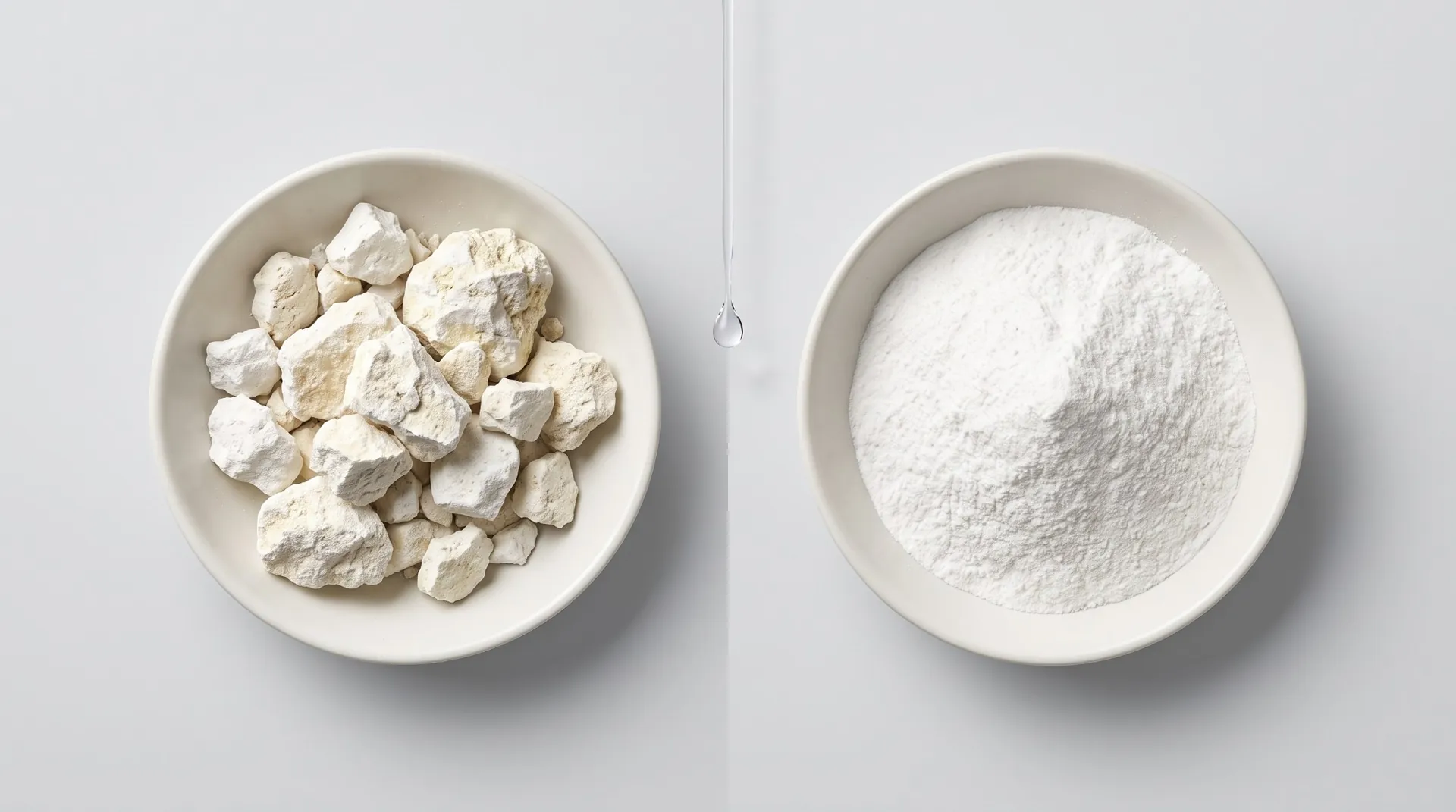
In short What is the difference between quicklime and hydrated lime? Quicklime (CaO) is made by burning limestone and reacts violently with water; hydrated lime (Ca(OH)₂) is the ready-to-use fine powder produced by slaking it. The choice depends on the application, the slaking equipment and storage conditions. The decision table in this article shows when to choose each.
Quicklime vs hydrated lime: what is the difference?
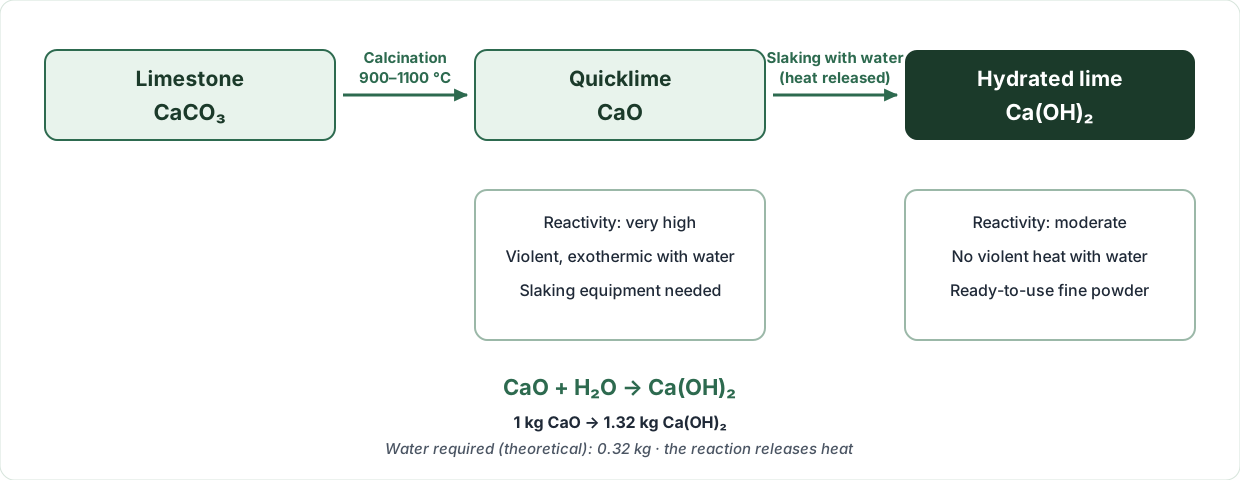
Lime has been used for thousands of years in everything from construction to metallurgy, agriculture and environmental protection, yet the terms “quicklime” and “hydrated lime” (also called slaked lime) are often confused. Both come from the same limestone and are consecutive links in one production chain: limestone is burnt to give quicklime (CaO), and quicklime is combined with water to give hydrated lime (calcium hydroxide, Ca(OH)₂). The differences run from chemical composition to reactivity, storage and the way the product is used.
| Property | Quicklime | Hydrated lime |
|---|---|---|
| Chemical formula | CaO (calcium oxide) | Ca(OH)₂ (calcium hydroxide) |
| Production | Calcination of limestone at 900–1100 °C | Hydration (slaking) of quicklime with water |
| Appearance | White to pale yellow | White, fine powder |
| Reactivity | Very high | Moderate |
| Reaction with water | Violent and exothermic (a lot of heat is released) | Does not release intense heat; sparingly soluble, forms a suspension (milk of lime) |
| Form of use | Mostly slaked on site before use | Used directly as dry powder or as milk of lime |
| Equipment needed | Slaking and dosing equipment | Dosing equipment is enough |
For a detailed look at production and quality parameters, see our article on how hydrated lime is produced and which quality parameters matter.
What is quicklime (CaO)?
Quicklime is the calcium oxide obtained by calcining (burning) limestone (CaCO₃) at a high temperature, roughly 900–1100 °C. During burning CaCO₃ decomposes and carbon dioxide is released, leaving a reactive solid that ranges from white to pale yellow. The reaction that releases intense heat on contact with water is both the strength of quicklime and the reason it needs care.
Vişne Madencilik's quicklime products are made in the kilns of its plants: the Çelemli plant operates 5 kilns and the Narlı plant 4, and the company states that the combined quicklime capacity of its three integrated plants exceeds 2,250 tonnes per day. For the product's properties, see the quicklime product page.
What is hydrated lime (Ca(OH)₂) and what happens during slaking?
Hydrated lime is the calcium hydroxide obtained by reacting quicklime with a controlled amount of water (hydration, or slaking). The reaction is written CaO + H₂O → Ca(OH)₂ and is exothermic. The product is a ready-to-use white, fine powder that behaves as a strong base in aqueous systems.
A stoichiometric calculation (our own, assuming pure substances) gives the following results:
| Input | Reaction | Result |
|---|---|---|
| 1 kg CaO | CaO + H₂O → Ca(OH)₂ | about 1.32 kg Ca(OH)₂ |
| Slaking 1 kg CaO | stoichiometric water demand | 0.32 kg water (theoretical) |
In other words, 1 kg of quicklime gives about 1.32 kg of hydrated lime when slaked and, in theory, needs 0.32 kg of water. In practice industrial slakers use more water than this theoretical amount, and the real yield depends on the purity of the raw material and on the slaking conditions. The calculation also shows why the question “is there a slaking unit?” matters: a plant that uses quicklime has to manage the water, the heat and the product dosing on its own site, whereas hydrated lime leaves that step to the supplier.
At Vişne Madencilik this step is carried out at the Lime Slaking Facility and Packaging Unit at Narlı, which opened on 17 April 2025. Hydrated lime is also among the products of the Çelemli plant. For more on the plants, see our factories page. The technical values of the product are on the hydrated lime product page.
Which one is preferred in which application?
There is no fixed rule: the choice depends on the plant's slaking and dosing equipment, daily consumption, storage space and the stream being treated. The table below summarises general tendencies and may vary with project conditions; a final decision needs the details of the application.
| Application | General tendency | Why |
|---|---|---|
| Iron, steel and metallurgy | Mostly quicklime | High reactivity and direct use in furnace processes |
| Water and wastewater treatment | Either; depends on plant scale and equipment | Dosing dry hydrated lime is simple; at large scale quicklime can be used with a slaking unit |
| Flue gas treatment | Mostly hydrated lime | Fine hydrated lime (d90 < 10 µm preferred) reacts quickly with acid gases |
| Food and sugar industry | Depends on the process; milk of lime is prepared | Milk of lime can be made either by slaking quicklime or by diluting hydrated lime |
This table is a selection guide, not a technical specification. You can request product information to choose the product that suits your application.
You can discuss which product suits your application with our technical team. Request product information to choose the right product for your application.
How do they differ in storage, transport and safety?
Both products must be kept dry and closed, but for different reasons. Quicklime heats up and reacts when it meets moisture, so it must be transported and stored without getting wet. Hydrated lime reacts with carbon dioxide in the air and loses its activity, which is why closed, dry storage is needed. The dust of both can irritate the skin, eyes and respiratory tract.
Hydrated lime is shipped in 25 kg kraft bags for small purchases and in 1-tonne big bags or bulk tankers for large purchases; bulk tankers can make a pressurised silo-to-silo transfer. For packaging and shipping options for quicklime, please check the product page or ask our sales team. For protective equipment, dosing and safe unloading steps, see our article on hydrated lime dosing and safe use. Always rely on the product's safety data sheet (SDS) for safety information; this article is not medical or legal advice.
Which five questions should you ask when choosing?
To choose the right product, put these questions to your supplier and to your own plant:
- Do you have slaking equipment? If not, hydrated lime or ready-made milk of lime requires less investment.
- What is your daily consumption? At high volumes it can be an advantage that quicklime carries more active calcium per unit of mass (1 kg CaO ≈ 1.32 kg Ca(OH)₂).
- What is the target pH and the dosing form? Whether dry powder or milk of lime is used depends on the process design.
- What are your storage space and delivery method? Bags, big bags and bulk tankers call for different storage arrangements.
- Which values are you looking for on the certificate of analysis? The values on the certificate, not the product name, should be the basis.
You will find the points to check in the purchasing process in our guide on what to check when buying hydrated lime in bulk.
Frequently asked questions
What happens when quicklime is mixed with water?
When quicklime (CaO) meets water it reacts violently and exothermically: a lot of heat is released and calcium hydroxide (Ca(OH)₂) forms. Slaking should therefore be done in a controlled way, with suitable equipment and protective gear. The product that results from controlled slaking is ready-to-use hydrated lime; for safety steps, rely on the product's SDS.
Which one is cheaper?
This cannot be answered by looking at the product price alone, and we do not publish prices here. A comparison should weigh purity, the amount of active calcium per unit of mass (1 kg CaO is equivalent to about 1.32 kg Ca(OH)₂), the need for slaking equipment, and the storage and shipping method together. For a current price you need to request a quotation.
Are both used in water treatment?
Yes. In water and wastewater treatment both products can be used for pH adjustment and neutralisation, and the choice depends on the plant's scale and equipment. Dosing dry hydrated lime is simpler, while quicklime requires a slaking unit. For lime to be used in drinking water treatment, the relevant standard and the supplier's declaration should be checked separately. See our water treatment application page for details.
Which one is easier to store?
Hydrated lime is generally easier to handle because it does not release intense heat with water; it should still be kept closed and dry, since it reacts with carbon dioxide in the air. Quicklime must be protected from moisture at all times, as getting wet leads to heating and reaction. For either product, the storage arrangement should follow the SDS and local regulations.
Which packaging can I buy in small volumes?
Vişne Madencilik offers hydrated lime for small purchases in 25 kg kraft bags; for large volumes there are 1-tonne big bags or bulk tanker options. Packaging options for quicklime may vary by product. If you tell us your monthly quantity and delivery point, we can agree on suitable packaging together; you can reach us through our contact page.
Which one should I choose for my application?
The decision depends on the target pH, daily consumption, existing slaking and dosing equipment and storage space. The decision table above shows only a general tendency; project conditions, product purity and process details can change it. Request product information; our technical team can help you assess the details of your application.
Conclusion
- Quicklime (CaO) is made by burning limestone; it reacts violently with water and needs slaking equipment.
- Hydrated lime (Ca(OH)₂) is the ready-to-use fine powder formed by slaking quicklime, and it is easier to handle.
- In theory 1 kg of quicklime gives about 1.32 kg of hydrated lime; the real yield depends on purity and conditions.
- The choice is made according to the application, slaking equipment, consumption, storage space and delivery method.
Request product information and a quotation for your project. The average response time is under 24 hours.
Phone: +90 232 463 00 03 · Email: sales@visnemadencilik.com
Sources
- Calcium hydroxide — Wikipedia (molar mass, naming, uses).
- Calcium hydroxide (Q182849) — Wikidata (CAS 1305-62-0).
- EN 459-1:2015 — Building lime, Part 1: Definitions, specifications and conformity criteria — CEN, 2015 (iTeh Standards record).
- Safe handling of lime — European Lime Association (EuLA), 2015.
- Vişne Madencilik, quicklime and hydrated lime product pages and factories page (product and plant values).
Author
Related articles
- What Is Hydrated Lime? Production, Quality and Uses — the production chain of calcium hydroxide and what its parameters mean.
- How to Use Hydrated Lime: Dosing, Storage and Safe Handling — dosing, preparing milk of lime, storage and workplace safety.
- Bulk Hydrated Lime Buying Guide — quality criteria, standards, packaging and the factors that affect price.