Ready-Mixed Concrete Production
It is the largest component of the mix by volume and provides the ultimate strength.
Main component of concrete


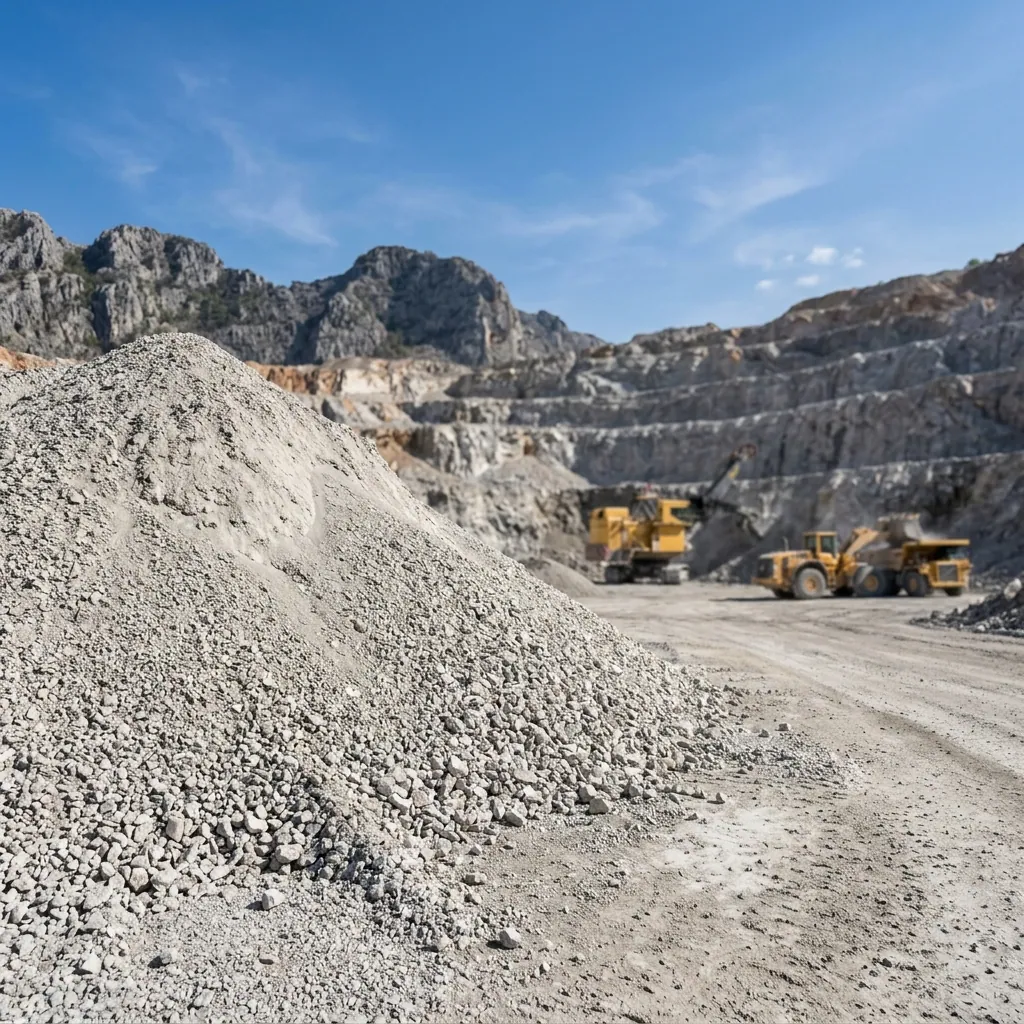
Aggregate is the general term for industrial minerals such as crushed stone, chippings, sand and gravel, which form the largest component by volume of building materials such as concrete and asphalt. As Vişne Madencilik, we produce crushed stone compliant with TS EN standards for reliable infrastructure.
Raw Material
Limestone (Calcareous)
Bulk Density
2400-2700 kg/m³
LA Abrasion
% 20-30
Standard Compliance
CE Marked
Aggregate is a term derived from the Latin root 'aggregare' (to bring together), and in construction engineering it refers to inert mineral particles that, when brought together with binders, form composite building materials. According to the TS 706 EN 12620 standard, aggregate is granular building material obtained from natural, artificial or recycled sources and used as a filler material in concrete and asphalt.
The basic function of aggregate is to fill volume and provide mechanical strength within concrete or asphalt. Critical structural properties such as thermal stability, abrasion resistance, load-bearing capacity and dimensional stability all depend on the physical qualities of the aggregate used.
Limestone (calcareous) sourced aggregates, with properties such as high compressive strength, low water absorption and easy workability, are among the most preferred raw materials for modern superstructure projects.
AGGREGATE CLASSIFICATIONS
Our limestone-based aggregate falls into the "Normal Aggregate" (2400-2700 kg/m³) class.
Optimized in accordance with quality control standards to ensure reliability in infrastructure and concrete projects.
| Property | Value Range | Description / Standard |
|---|---|---|
| Material Type | Limestone (Calcareous) | Natural crushed aggregate |
| Bulk Density | 2400-2700 kg/m³ | Normal-weight aggregate class |
| Los Angeles Abrasion | Stated in the certificate of analysis | Test method: TS EN 1097-2 |
| Water Absorption | Stated in the certificate of analysis | Requirement for high-quality concrete and asphalt |
| Size Fractions | 0-5 mm, 5-12 mm, 12-19 mm... | Grading according to application area |
| Colour | Grey/White | Characteristic limestone colour |
| Certification | Under CPR 305/2011 | Ask our team for valid certificate details |
Aggregate is the general name for mineral particles such as crushed stone, chippings, sand and gravel, which make up most of the volume in concrete, asphalt and road infrastructure. Its quality depends on many parameters, from the raw material to particle shape and cleanliness. This section summarises how aggregates are classified, which tests are applied and which standard applies to which use.
| Criterion | Classes |
|---|---|
| Particle size | Fine (below about 4 mm) and coarse (above 4 mm) |
| Source | Natural, crushed and recycled |
| Particle density | Lightweight, normal-weight and heavyweight |
| Property | Test | Standard series |
|---|---|---|
| Abrasion resistance | Los Angeles abrasion test | TS EN 1097-2 |
| Particle size distribution (grading) | Sieve analysis | TS EN 933-1 |
| Particle shape | Flakiness index | TS EN 933-3 |
| Water absorption | Particle density and water absorption | TS EN 1097-6 |
| Frost resistance | Freeze-thaw test | TS EN 1367-1 |
| Cleanliness | Methylene blue test | TS EN 933-9 |
The required tests and acceptance limits vary according to the intended use and the project specification. For batch values, rely on the certificate of analysis.
| Use | Relevant standard |
|---|---|
| Aggregates for concrete | TS EN 12620 |
| Bituminous mixtures (asphalt) | TS EN 13043 |
| Unbound or hydraulically bound mixtures | TS EN 13242 |
| Railway ballast | TS EN 13450 |
As harmonised standards, these are assessed in the context of CE marking and the EU Construction Products Regulation (CPR 305/2011). Please ask our sales team for the valid documents and the declaration of performance for your product.
In road construction, quicklime is applied before the aggregate layers to stabilise clayey and moist soils; in asphalt mixtures, hydrated lime is added in a small proportion as an anti-stripping additive. The quantity to be used is determined by soil and mix tests. For the products, see the quicklime and hydrated lime pages. For more detail, see the difference between quicklime and hydrated lime and how to use, store and handle hydrated lime safely.
Vişne Madencilik's Çukurova / Gündoğan (Ceyhan, Adana) site has a limestone quarry and a crushing and screening plant; the CaCO₃ content of the limestone is above 97% according to the company's statement. For the plants, see our factories page.
Aggregate, indispensable to modern infrastructure, fills volume everywhere from durable living spaces to advanced road networks.
It is the largest component of the mix by volume and provides the ultimate strength.
Main component of concreteCrushed stone with a rough surface texture and low abrasion value extends the service life of hot bituminous mix pavements.
Main component of asphaltCrushed stone of various gradations is laid in granular sub-base (GSB) and granular base (GB) layers to distribute loads.
Base MaterialA high-strength coarse crushed stone laid beneath the track that performs vibration damping and drainage functions.
TS EN 13450Used to create highly water-permeable layers (French drains) and for aesthetic purposes in landscaping applications such as walkways.
Optimum DrainageOur aggregate production processes are supported by accredited laboratory tests, providing a superior quality guarantee.
Measures the resistance of the aggregate to mechanical abrasion (TS EN 1097-2). The acceptable loss category depends on the intended use.
The conformity of aggregates to ideal grading curves is regularly checked through tests carried out in accordance with the TS EN 933-1 standard.
Resistance to freeze-thaw cycles is tested to ensure the durability of concrete and asphalt in cold climate conditions.
The relevant harmonised standards under CPR 305/2011 are TS EN 12620, TS EN 13043 and TS EN 13242; ask our sales team for the valid certificate and declaration of performance for your product.
With our sustainable infrastructure approach, dust emissions are controlled and depleted quarry sites are restored back to nature.
The most commonly asked topics about our aggregates regarding their areas of use and technical specifications.
Contact our professional team right away for information about your aggregate needs, stock availability and shipping details.