Container Transport
In maritime transport the container body is exposed to temperature fluctuations. Our products eliminate "container rain" by preventing condensation.
Condensation Control


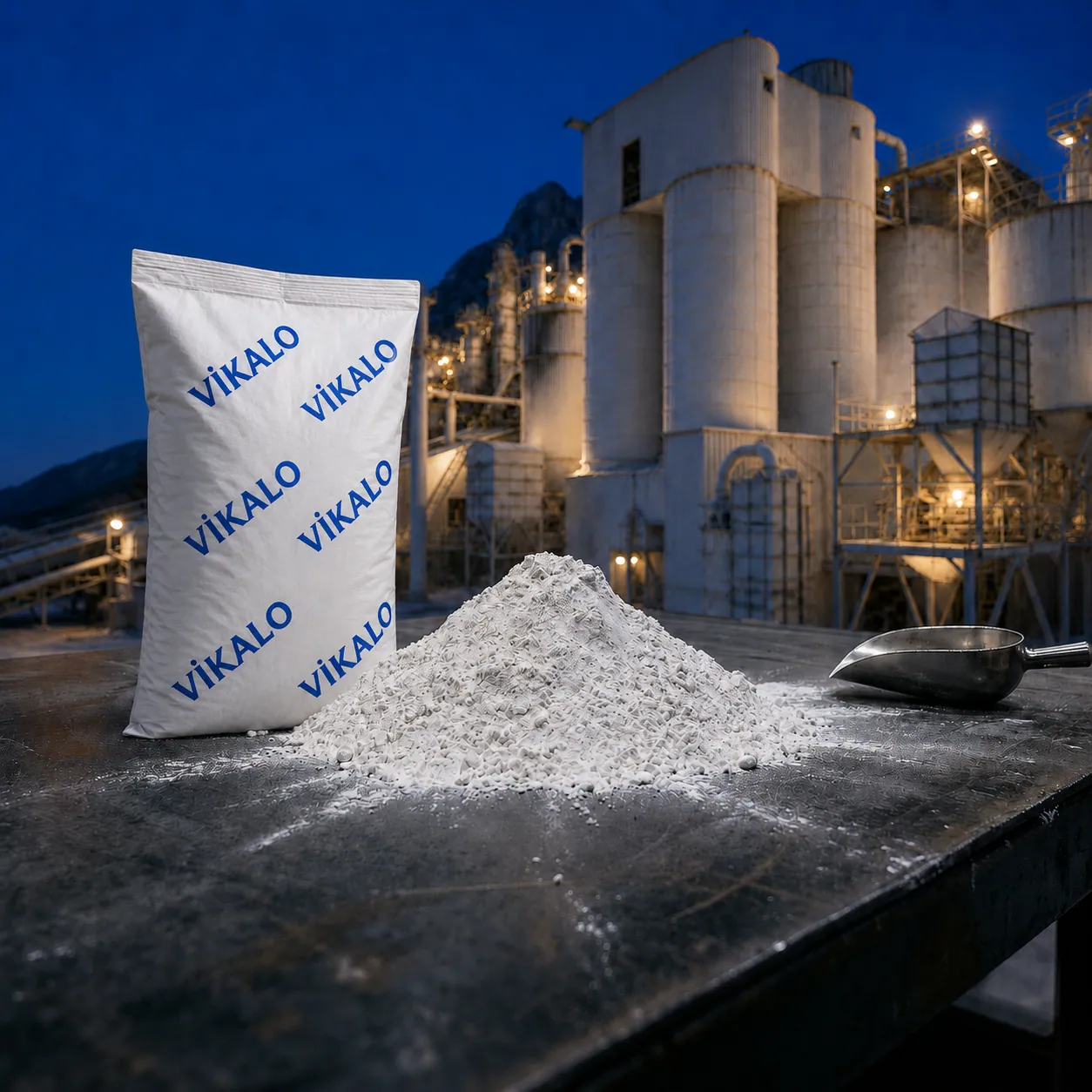
Across a wide range from logistics processes to heavy industry, it permanently absorbs moisture-related damage (container rain) and harmful gas emissions in industrial stacks (FGD).
Chemical Bonding
No Re-release (No Sweating)
Discharge Treatment
Effective on SO₂ and HCl
Protection Method
Desiccant and Injection
EU Standard
Within IED and BAT Scope
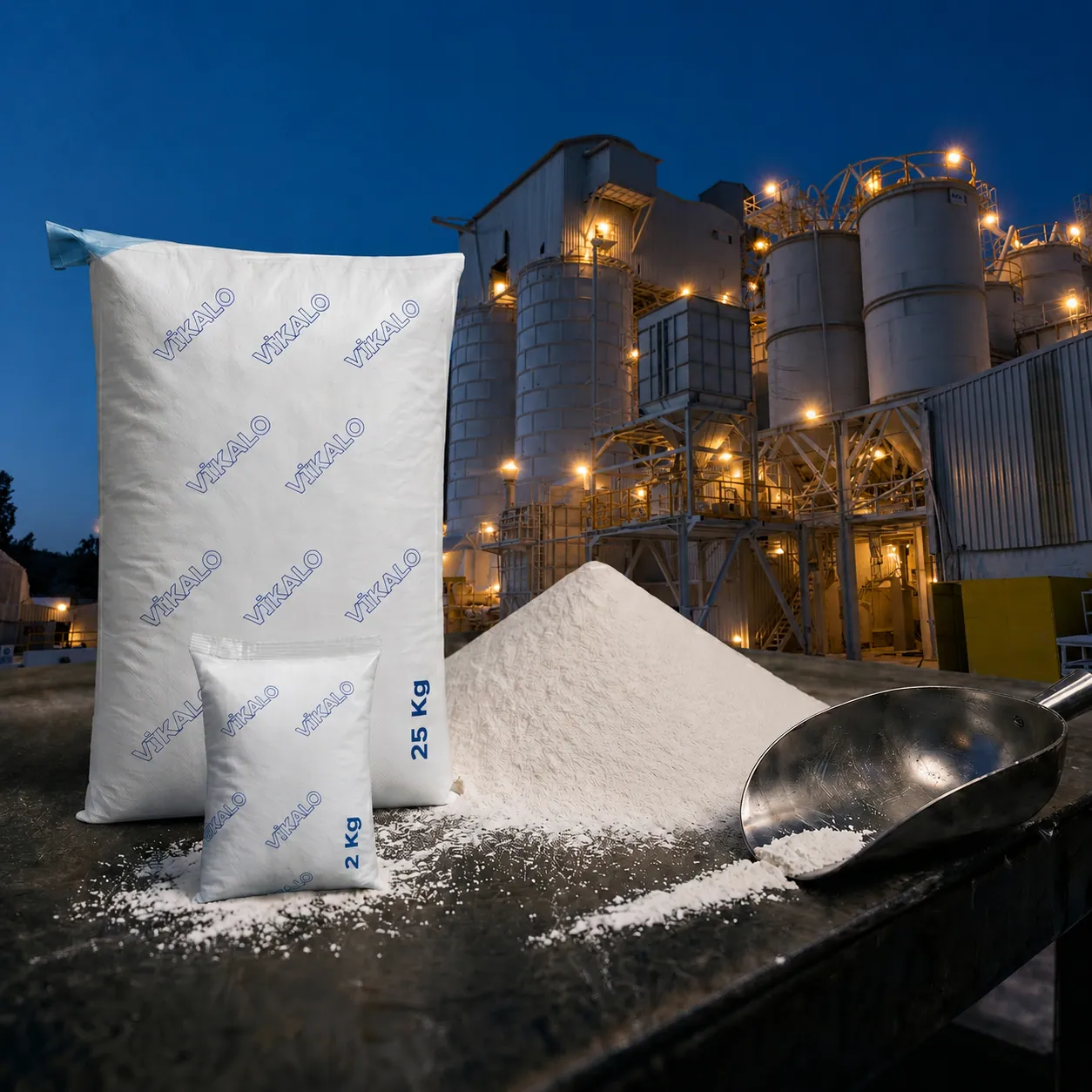
Moisture absorbent (Desiccant): Industrial substances that lower the relative humidity and prevent condensation by absorbing water from the air in enclosed environments. Because lime-based (CaO) products bind chemically with water, unlike silica gel fillers they do not spit the sweat / moisture back into the container or warehouse during temperature fluctuations.
Gas absorbent: Hydrated lime-based products (Ca(OH)₂) that absorb the acid-character sulphur and chlorine gases found in the flue gases of industrial facilities. Emissions such as sulphur dioxide (SO₂) and hydrogen chloride (HCl) are converted into salt and water, providing a clean discharge from the stack.
These lime-based protective systems represent the true hidden force in cyclical industrial production and product preservation.
WORKING PRINCIPLE SUMMARY
Engineering performance values based on active components and standard compliances are provided below.
| Property | Absorbent / Value Range | Description / Standard |
|---|---|---|
| Active Component | CaO (Moisture Abs.) / Ca(OH)₂ (Gas Abs.) | Lime-based active chemical |
| Working Principle | Chemical absorption / Acid-base | Permanent bond, not physical adsorption |
| Target Pollutants | Water vapour, moisture, SO₂, HCl, HF, H₂S | In-container moisture and flue gases |
| Typical Efficiency (Moisture) | %25-35 of its weight | High and permanent water absorption |
| Typical Efficiency (Gas) | Sistem tasarımına bağlıdır | Depending on the scrubbing technology used |
| Application Form | Desiccant bag / Dry Injection | Granule, powder or liquid suspension |
| Field of Use | Logistics, Transport and Flue Gas (FGD) | Industrial-scale protection and treatment |
Lime-based moisture and gas absorbers rely on chemical reactions involving calcium oxide (CaO) and calcium hydroxide (Ca(OH)₂). Unlike materials that hold moisture physically, they bind water and acid gases chemically. This section summarises the working principle and the information needed to choose the right product.
Calcium oxide reacts with water and turns into calcium hydroxide: CaO + H₂O → Ca(OH)₂. In theory, 1 kg of CaO can bind about 0.32 kg of water; in other words, it takes up moisture equal to roughly one third of its own weight. Because the reaction is chemical, the bound moisture is not released again when the temperature changes, unlike with materials that work by physical adsorption, such as silica gel. For more detail, see the difference between quicklime and hydrated lime.
Container rain is the condensation that forms on the inner surfaces of containers that pass through different temperature zones during sea transport. Binding the water vapour in the air lowers the relative humidity and reduces the risk of condensation. The effect depends on the cargo, the packaging and the conditions of the voyage.
In flue gas treatment, hydrated lime neutralises acid gases and converts them into calcium salts. According to our stoichiometric calculation, at least 1.016 kg of pure Ca(OH)₂ is required for 1 kg of HCl and at least 1.157 kg for 1 kg of SO₂; actual consumption exceeds this lower limit depending on the purity of the product and the reaction efficiency.
| Gas | Reaction | Pure Ca(OH)₂ required (per 1 kg of gas, lower limit) |
|---|---|---|
| Hydrochloric acid (HCl) | Ca(OH)₂ + 2 HCl → CaCl₂ + 2 H₂O | 1.016 kg |
| Sulphur dioxide (SO₂) | Ca(OH)₂ + SO₂ → CaSO₃ + H₂O | 1.157 kg |
In dry injection, the powder sorbent is fed directly into the gas; in semi-dry systems, milk of lime is sprayed. Very fine particles (d90 < 10 µm) react faster with acid gases. Efficiency depends on the design, the temperature, humidification and the stoichiometric ratio. For more detail, see how to use, store and handle hydrated lime safely.
Vişne Madencilik has produced lime since 1952; its three integrated plants are located in Adana and Kahramanmaraş. The company states that its combined quicklime capacity exceeds 2,250 tonnes per day and that it exports to more than 30 countries. For the product range, see the quicklime and hydrated lime pages, and for the plants, our factories page.
The beneficial advantages it provides to protect raw materials, finished goods and processes against environmental risks.
In maritime transport the container body is exposed to temperature fluctuations. Our products eliminate "container rain" by preventing condensation.
Condensation ControlProtection of products such as metal parts, machine equipment, food and seeds against corrosion and mould during long-term storage.
Permanent ProtectionFlue gas desulphurisation in thermal power plants and energy facilities. Neutralisation of acid gases (SO₂, HCl, HF).
SO₂ RemovalEmission control of acid gas and dioxin precursors in the thermal disposal of municipal and industrial waste.
HCl RemovalHydrogen sulphide (H₂S) removal at biogas plants, odour control at landfills and emission reduction at clinker stacks.
Compliance with Environmental PermitsThe main guidelines used in selecting absorbent products and integrating them into injection systems.
Unlike materials that merely adsorb, such as silica gel, CaO binds water chemically via the equation CaO + H2O → Ca(OH)2. When the temperature rises there is no risk of re-release (sweating).
For plant stacks we supply the appropriate lime, with technical support, for all dry injection (Dry), semi-dry scrubbing or full wet scrubbing (Scrubber) systems.
In Dry Injection systems (DSI), flue gas temperatures are kept within the range suited to the system design so that the reaction proceeds at maximum benefit.
Our products (the Vikalo® series) are fully compliant with the "Best Available Techniques" (BAT) under the EU Industrial Emissions Directive (IED).
By increasing the sorbent's surface area and the reactive purity of CaO / Ca(OH)2, maximum capacity per bag or per tonne is achieved.
Engineering questions frequently received regarding thermal systems and logistics protection.
Meet our engineering team right away for integrated flue gas treatment systems and industrial moisture and gas absorbent solutions against transport risks.