


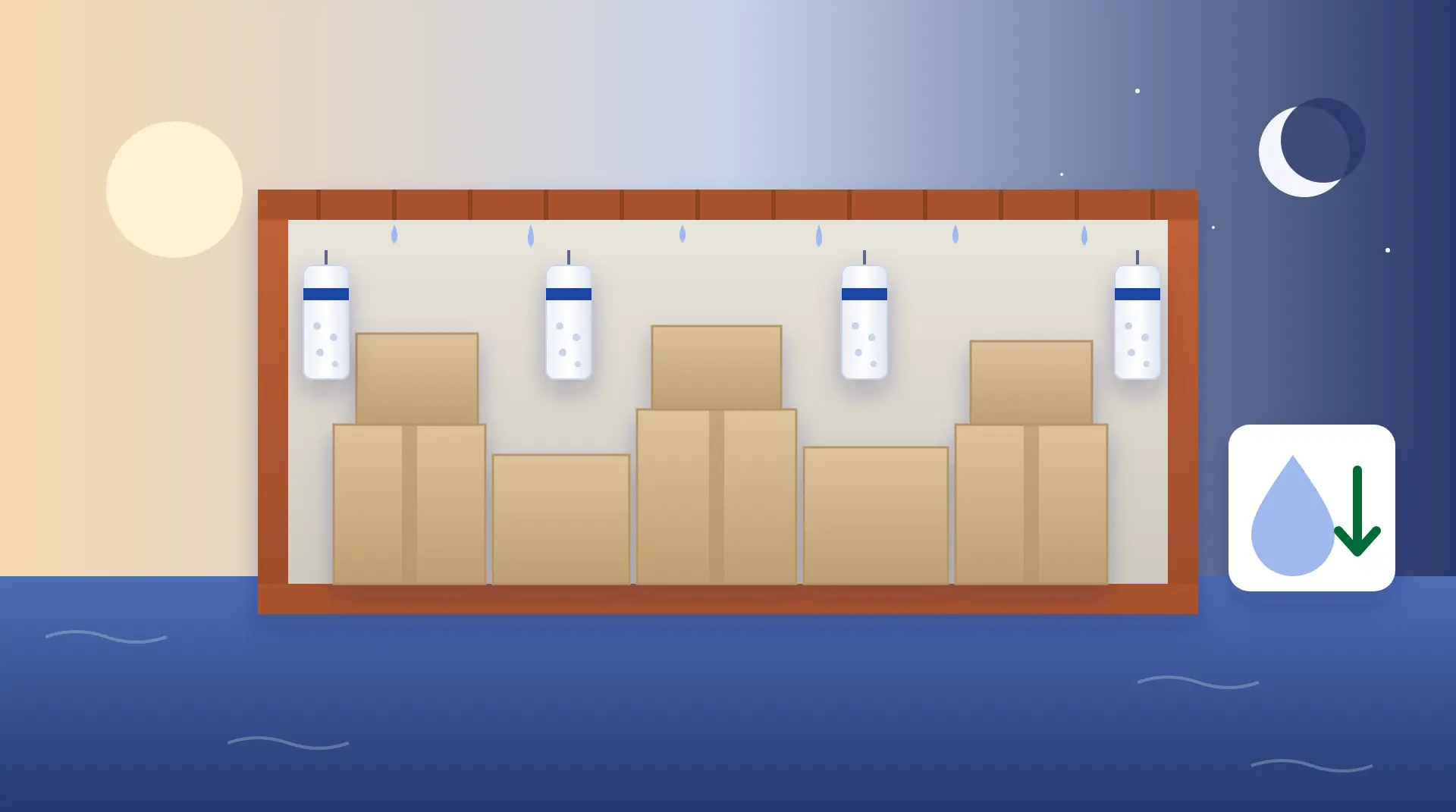
In short Container moisture absorbers are used to reduce the condensation that forms during transport ("container rain"). There are three common options: lime-based (CaO) moisture absorbers, which bind moisture chemically; silica gel, which holds it in its pores; and calcium chloride, which draws in moisture and turns into a liquid. The right choice depends on the cargo, the route, the voyage duration and the packaging design.
What is container rain and why does it occur?
Container rain is condensation that collects on the inner surfaces of a container during sea and land transport and drips onto the cargo. Humid air in a container that has warmed up during the day cools down at night or when the container enters a colder climate zone. When the air falls below its dew point, the moisture condenses first on the ceiling and walls, then drips onto the cargo.
Outside air is not the only source of moisture in a container. Moisture-holding goods such as wooden pallets, cardboard packaging and agricultural products also release water vapor into the air. The result is corrosion, mold, damaged labels and packaging, and loss of cargo value. We explain the general principles of moisture control in warehouses and production areas on our industrial moisture and humidity control page.
How do moisture absorbers work?
Moisture absorbers capture water vapor from the air in three different ways:
- Chemical binding (calcium oxide, CaO): Quicklime reacts with water: CaO + H₂O → Ca(OH)₂. The water becomes part of the calcium hydroxide structure. At normal transport temperatures, this reaction does not reverse.
- Physical retention by adsorption (silica gel): Silica gel holds moisture on the surface of its pores. When heated, it releases the moisture again, which is what allows it to be reused.
- Retention by dissolving (calcium chloride): Calcium chloride is a salt that both attracts moisture (hygroscopic) and dissolves in the moisture it absorbs (deliquescent). The water it captures therefore becomes liquid and must be collected in a leak-proof reservoir.
This quicklime reaction is also used in lime slaking and in preparing the lime slurry used in flue gas treatment. The gas absorbent side of the same Vikalo® product family captures acid gases in flue gas desulfurization.
How do CaO, silica gel and calcium chloride compare?
Each of the three options has its strengths and weaknesses. The table below summarizes the differences:
| Property | Lime-based (CaO) | Silica gel | Calcium chloride |
|---|---|---|---|
| Mode of action | Chemical binding | Physical retention in pores | Draws in moisture and turns into a solution |
| Captured water | Remains in solid Ca(OH)₂ | Remains in the pores | Becomes a liquid solution |
| When the temperature rises | Does not release water at normal transport temperatures | Releases moisture when heated (regenerated at about 120 °C) | If the reservoir is not leak-proof, the liquid can wet the cargo |
| Capacity | Theoretically about 32% of its own weight | Up to 37% of its own weight at high humidity | Draws in moisture until it turns into a solution; the amount depends on ambient humidity |
| Point to watch | The reaction releases heat and the volume increases; irritant | Regenerable; cannot absorb more moisture once saturated | Requires a leak-proof reservoir and correct positioning |
Source: Silica gel values and calcium chloride properties are taken from the relevant Wikipedia articles; CaO capacity is calculated from the reaction equation.
Where a lime-based moisture absorber stands out is not capacity but the fact that the binding is permanent and no liquid forms. Silica gel and calcium chloride are also effective solutions with the right packaging and in the right application.
How much moisture does 1 kg of CaO bind?
Theoretically, 1 kg of calcium oxide binds about 0.32 kg of water. The figure comes from the reaction equation: 56.08 g of CaO reacts with 18.02 g of water (18.02 / 56.08 = 0.321). That is about one third of its own weight.
In practice, this value may not be fully reached. Actual performance is reduced by:
- the CaO content of the product (it is not 100% pure),
- the product reacting with moisture in the air before the packaging is opened,
- the vapor permeability of the packaging and the position of the moisture absorber in the container,
- the voyage duration and temperature.
When comparing moisture absorber offers, look at the cost per unit of water that can be bound, not the price per gram. To do this, ask the supplier for test conditions showing how much water the product absorbs at what relative humidity and temperature, and over how many days. We explain the comparison logic in detail in our offer comparison method.
What determines how much moisture absorber you need?
The required quantity cannot be given as a single fixed number. To determine it, you need the following information:
- Container type and volume: 20 or 40 feet, standard or high cube.
- Cargo: Is it a product that holds or releases moisture (wood, paper, agricultural produce), and how sensitive is it to moisture?
- Packaging materials: Wooden pallets and cardboard bring additional moisture into the container.
- Route and climate zones: Moving from hot, humid regions to cold regions increases condensation.
- Voyage duration: The longer the voyage, the greater the total moisture load.
- Loading conditions: Loading in rainy weather or on wet ground brings in additional moisture.
If this information is ready, we can determine the right quantity together.
Let us determine the right quantity together, based on your container type, cargo, route and voyage duration. Request a technical assessment for moisture absorbers.
Where and how should a container moisture absorber be placed?
Moisture absorbers are placed in the upper part of the container and on the side walls, where warm, humid air collects. They should not touch the cargo and should be secured so that they are not damaged if the cargo shifts.
- Place them just before loading; a product whose packaging is opened early absorbs moisture before the transport begins.
- Make sure that pallets and packaging are dry.
- If you use calcium chloride, check that the liquid reservoir stays upright and leak-proof.
- On long or critical shipments, measure the result with a temperature and humidity data logger.
What should you watch for when using a lime-based moisture absorber?
Calcium oxide is an irritant; if inhaled, or on contact with moist skin and eyes, it causes serious irritation. Its reaction with water also releases heat, and the product's volume increases. Therefore:
- The product should only be used in its purpose-designed packaging, which lets vapor through but not dust.
- It must not come into direct contact with food; for food cargo, suitability should be assessed according to the packaging design and local regulations.
- Unused product should be stored in its original, closed packaging in a dry place.
- The safety data sheet (SDS) should be read and occupational safety principles applied.
Vişne Madencilik's lime-based Vikalo® moisture absorbers are listed on the Moisture & Gas Absorbent product page. For the active ingredient, quicklime, see our Quicklime product page. For the products used on the gas side of the same product family, read our guide to hydrated lime for flue gas treatment.
Frequently asked questions
Why does a lime-based moisture absorber not release the water again?
Calcium oxide does not hold water physically; it reacts with it to form calcium hydroxide. The water is no longer free but part of the newly formed compound. So when the container warms up, the moisture is not expected to be released, as it can be with materials that work by physical adsorption, such as silica gel. The effect of the moisture absorber still depends on the cargo, the packaging and the voyage conditions.
Silica gel or a lime-based moisture absorber?
Silica gel is practical in small sachets and in reusable applications; at high humidity it can hold up to 37% of its own weight in moisture, but as temperature and humidity change, it can release part of the moisture it holds. A lime-based moisture absorber, by contrast, binds moisture permanently and forms no liquid. On long voyages and on routes with large temperature swings, permanent binding has the advantage.
Can calcium carbonate also be used as a moisture absorber?
No. Calcium carbonate (CaCO₃) is chemically stable and does not react with water. In lime-based moisture absorbers, the substance that binds the moisture is calcium oxide. Because the two products are often confused, we also clarify this distinction in our calcium carbonate guide.
When should the moisture absorber be put in place?
It should be put in place just before loading. A moisture absorber whose packaging is opened early, or which is left in the open air for a long time, uses up part of its capacity before transport. Before the container doors are closed, check that the moisture absorbers are secured and do not touch the cargo.
How should a used moisture absorber be disposed of?
A used lime-based moisture absorber consists mainly of calcium hydroxide and is still alkaline. Waste should be managed in line with local regulations. Follow the disposal and occupational safety sections of the product's safety data sheet, and do not touch product from torn packaging with bare hands.
What information should I share for a quote?
Container type and number, type of cargo, route, voyage duration and shipment frequency are enough for a preliminary assessment. If you ship food or sensitive cargo, please mention this as well. With this information, send your moisture absorber quote request.
Conclusion
- Container rain is moisture that condenses as the temperature drops and drips onto the cargo; it causes corrosion, mold and packaging damage.
- Lime-based moisture absorbers bind moisture chemically, silica gel holds it in its pores, and calcium chloride turns into a solution.
- Theoretically, 1 kg of CaO binds about 0.32 kg of water; practical performance depends on purity, packaging and conditions.
- The required quantity should be calculated from the cargo, packaging, route and voyage duration.
Send us your lime-based moisture absorber requirements for your shipments, together with container, cargo and route details. We respond to your request within 24 hours.
Phone: +90 232 463 00 03 · Email: sales@visnemadencilik.com
Sources
- Calcium oxide — Wikipedia (molar mass, reaction with water, safety).
- Silica gel — Wikipedia (adsorption, capacity, regeneration temperature).
- Calcium chloride — Wikipedia (hygroscopic and deliquescent properties, use as a desiccant).
- Safe handling of lime — European Lime Association (EuLA), 2015.
- Vişne Madencilik: Moisture & Gas Absorbent product page and industrial moisture and humidity control page (product and application information).
Author
Related articles
- What is micronized calcium carbonate? — particle size, whiteness and grade selection.
- Hydrated lime for sale: how to compare offers — the cost-per-active-substance method.
- Lime in flue gas desulfurization — lime-based gas treatment methods.
- How to select hydrated lime for flue gas treatment — specification and trial plan.