


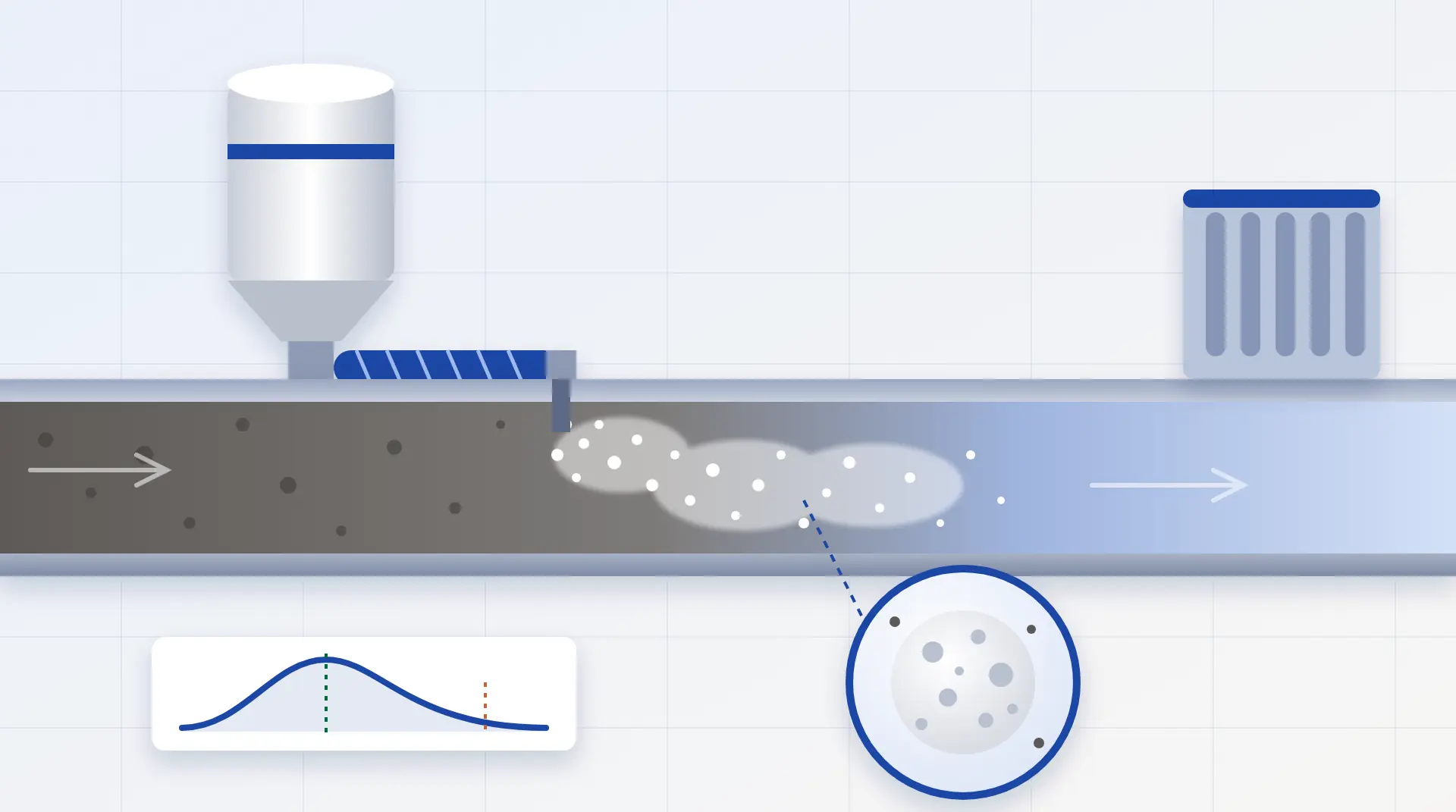
In short When choosing hydrated lime for flue gas treatment, check four values: available Ca(OH)₂ content, particle size distribution, BET specific surface area and the CO₂ content, which indicates carbonation. These values determine consumption and efficiency in dry injection and semi-dry systems. The right product is confirmed not by a data table but by a measured trial at your plant.
What determines the performance of hydrated lime for flue gas treatment?
The performance of hydrated lime (calcium hydroxide, Ca(OH)₂) in flue gas is determined by two groups of factors: the product itself and the plant conditions. On the product side, purity, fineness and surface area matter most. On the plant side, gas temperature, humidity, residence time, filter type and the Ca/S molar ratio are decisive. We compared which reagent is used in which method in our guide to flue gas desulfurization methods.
This choice is particularly important in dry sorbent injection (DSI). According to the EU Large Combustion Plants BREF, residence time in DSI is only 0.5–3 seconds. Without sorbent recirculation, typically only 15–30% of the Ca(OH)₂ reacts with SO₂. A product that can react within this short time means less lime for the same removal.
Which values should the certificate of analysis show?
Whether a batch is suitable for flue gas treatment becomes clear only when the values on the certificate are read together. The table below summarizes what each value tells you and how to request it.
| Value | Why it matters | How to request it |
|---|---|---|
| Available Ca(OH)₂ (%) | Directly determines the dosing calculation | As a percentage on the certificate, with the test method |
| CaO + MgO (%) | Indicator of overall purity | Using EN 459 series methods |
| CO₂ (%) | Carbonated portion that does not react | Measured value for every batch |
| Particle size (d50, d90 or d97) | Reaction rate and dispersion in the duct | Distribution measured by laser diffraction, with the method name |
| BET specific surface area (m²/g) | Surface in contact with the gas | Value measured to ISO 9277 |
| Free moisture (%) | Flowability, caking, dosing stability | As a percentage on the certificate |
| Bulk density (g/cm³) | Silo volume and dosing equipment settings | Loose bulk density value |
The standard values published on Vişne Madencilik's hydrated lime product page are: CaO + MgO ≥ 90% (typically > 93%), CO₂ ≤ 7%, fineness (passing 90 µm) ≥ 93% and bulk density 0.30–0.60 g/cm³. According to our company's technical note, very fine products (d90 < 10 µm) are preferred in flue gas treatment. At the quotation stage, confirm in writing the fineness and surface area values your application requires.
When do you need high-surface-area hydrated lime?
High-surface-area hydrated lime makes a difference in systems where residence time is short and sorbent utilization remains low. The BREF states that special hydrated lime with a high specific surface area increases sorbent utilization in DSI and can reduce or even eliminate the need for sorbent recirculation.
The decision between a high-surface-area product and a standard product should be based not on the price per ton but on the total cost per kilogram of SO₂ or HCl captured. A high-surface-area product is worth considering if:
- the duct is short and residence time is low,
- there is no sorbent recirculation,
- the target emission value cannot be met with a standard product,
- reducing the amount of ash and residue is important.
Do not look at the BET value alone. Particle size distribution, purity and a trial under real plant conditions should be evaluated together.
Hydrated lime, sodium-based sorbent or limestone?
The choice depends on the system type and the target. According to the BREF, the most common sorbents in dry injection are dry hydrated lime, sodium bicarbonate and lime slurry. Furnace injection uses ground limestone and dolomite, which calcine in the furnace heat and turn into reactive CaO.
| Sorbent | Where it is used | Strength | Point to watch |
|---|---|---|---|
| Hydrated lime | In-duct DSI, spray dryers, CFB | Ready to use; calcium-based residue | Sorbent utilization can be low in DSI |
| Sodium bicarbonate | In-duct DSI | SO₂ removal usually higher | Usually needs fine grinding immediately before injection; the sodium salt residue cannot always be utilized |
| Ground limestone | Furnace injection, wet scrubbers | Low reagent cost | Particle size and reactivity determine efficiency |
For limestone-based options, we explain how to read fineness in our article on micronized calcium carbonate.
How do you plan a plant trial?
A measured trial is the most reliable way to find out how much of a hydrated lime product your plant will consume. The following steps let you compare two products, or two dosing levels, fairly:
- Baseline measurement: With the current product, under representative load and fuel conditions, record SO₂, HCl and consumption data with the continuous emission monitoring system (CEMS).
- Keep conditions constant: The injection point, gas temperature, humidification and filter settings should not change during the trial.
- Step-wise dosing: Start the new product at a low feed rate and increase it step by step; at each step, wait for emissions to stabilize.
- Monitor side effects: Record filter pressure drop, ash quantity and deposits in the duct.
- Normalize the result: Express consumption as "kilograms of product per kilogram of pollutant captured".
- Convert to cost: Multiply this consumption by the delivered product cost and compare both options in the same unit.
You can review your trial plan and specification with our technical team. Talk to our team about your flue gas application.
What should you watch for in storage and dosing systems?
Hydrated lime gradually carbonates with carbon dioxide from the air and loses its effectiveness. Silos and packaging should therefore be kept closed and dry. Moisture impairs product flow and causes caking in dosing screws or pneumatic lines.
- Check the silo vent filter and the fluidization system regularly.
- Verify dosing accuracy on a mass basis, even if the bulk density changes.
- If you use a fabric filter, control humidification carefully. The BREF warns that excessive moisture can lead to wet deposits on the filter.
- Use personal protective equipment; lime dust irritates the eyes and skin.
We cover dosing, lime slurry preparation and occupational safety principles in detail in our guide to using and storing hydrated lime.
What should the specification include when you request a quote?
A good specification enables suppliers to submit comparable offers. State the following clearly:
- application and system type (in-duct DSI, spray dryer, CFB),
- gas flow rate, temperature and SO₂, HCl and HF concentrations,
- minimum available Ca(OH)₂ and maximum CO₂ values,
- particle size (d50 and d90 or d97) and, if needed, the BET value, together with the test methods,
- monthly consumption, packaging (bags, big bags, bulk tanker) and delivery point,
- a certificate of analysis for every batch and a safety data sheet (SDS).
To compare the offers you receive by cost per unit of active substance rather than price per ton, you can use our method for comparing offers by active-substance cost.
Our lime-based Vikalo® gas absorbents for acid gas treatment are listed on the Moisture & Gas Absorbent product page. The moisture absorber side of the same product family is used in containers and warehouses.
Frequently asked questions
Is high-surface-area hydrated lime always necessary?
No. Standard hydrated lime can be sufficient in many spray dryer and CFB systems. High-surface-area products come into their own in dry injection systems with short residence times and where the target emission value is demanding. The right decision comes from comparing the total cost per unit of pollutant captured in a trial at your plant.
At what gas temperature should hydrated lime be used?
The suitable temperature depends on the system design. According to the BREF, spray dryers typically operate 20–30 K above the saturation temperature of the gas. In duct injection, the sorbent can be injected into a cooler section of the duct to avoid the risk of sintering and melting. Confirm the suitable range for your system with the designer and the equipment manufacturer.
Does hydrated lime also capture HCl in flue gas?
Yes. Hydrated lime also reacts with acid gases such as HCl and HF. Based on the reaction Ca(OH)₂ + 2HCl → CaCl₂ + 2H₂O, at least 1.016 kg of pure Ca(OH)₂ is needed per 1 kg of HCl. The BREF states that SO₃ and HCl removal in spray dryers ranges from 95% to over 99%.
Does it matter whether you have a fabric filter or an electrostatic precipitator?
Yes. According to the BREF, in an electrostatic precipitator humidification both activates the sorbent and conditions the dust, which maintains filter efficiency. With a fabric filter, humidification must be carefully controlled to avoid wet deposits on the filter. Because the filter type directly affects dosing and humidification settings, it should be stated in the specification.
How long should the trial last?
The trial should last long enough to cover the plant's representative load and fuel conditions. At each dosing step, wait for emissions to stabilize, and take the baseline measurement under the same conditions. Short trials at a single load level can give misleading results.
What information should I share for a quote?
System type, gas flow rate and temperature, pollutant concentrations, target emissions, monthly consumption, packaging and delivery point are enough for a preliminary assessment. Also state the values you want to see on the certificate of analysis. With this information, send us your request for a technical assessment and quote.
Conclusion
- Selecting hydrated lime for flue gas treatment relies on reading the available Ca(OH)₂, particle size, BET surface area and CO₂ values together.
- High-surface-area products offer an advantage especially in dry injection systems with short residence times.
- A measured plant trial confirms the right product and dosage; the result should be compared by cost per unit of pollutant captured.
- The specification should clearly state the values, test methods, packaging and batch certificate.
Send us your hydrated lime or gas absorbent requirements and your specification for your flue gas system. We respond to your request within 24 hours.
Phone: +90 232 463 00 03 · Email: sales@visnemadencilik.com
Sources
- Best Available Techniques (BAT) Reference Document for Large Combustion Plants — European Commission Joint Research Centre (JRC), 2017, EUR 28836 EN (sections 3.1.3.3, 3.2.2.2; Tables 3.13 and 3.15).
- ISO 9277:2022 — Determination of the specific surface area of solids by gas adsorption — BET method — ISO, 2022.
- Using Lime for Flue Gas Treatment — National Lime Association (USA).
- Safe handling of lime — European Lime Association (EuLA), 2015.
- Vişne Madencilik: Hydrated Lime and Moisture & Gas Absorbent product pages (product values and technical notes).
Author
Related articles
- Lime in flue gas desulfurization — which reagent is used in wet, semi-dry and dry methods?
- Hydrated lime for sale: how to compare offers — calculating delivered cost per unit of active substance.
- What is micronized calcium carbonate? — a guide to reading particle size distribution.
- How to choose a container moisture absorber — lime-based moisture absorbers compared with other options.