


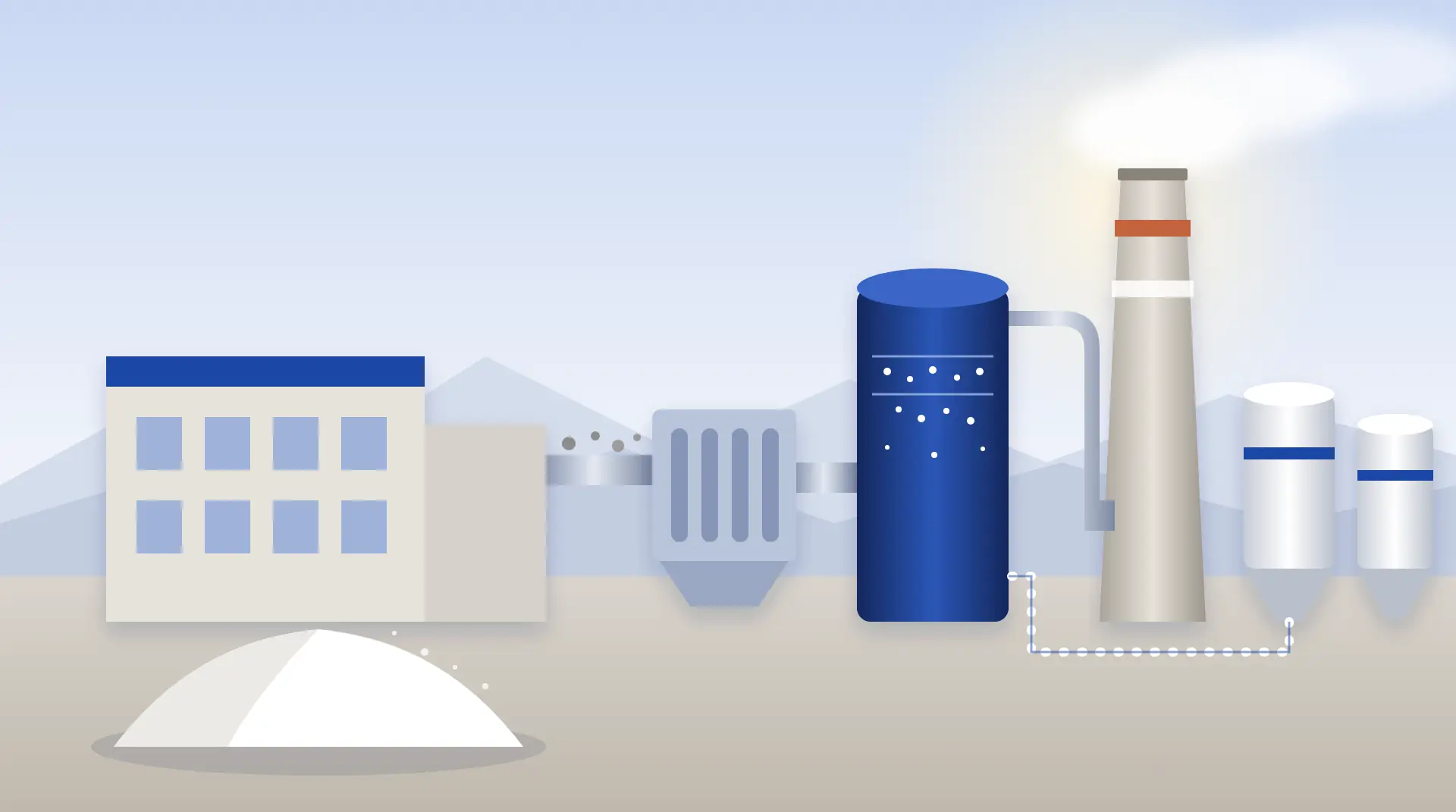
In short Flue gas desulfurization (FGD) uses three calcium reagents: mostly finely ground limestone in wet scrubbers, lime slurry in semi-dry spray dryers and powdered hydrated lime in dry injection. The choice of flue gas desulfurization lime or limestone depends on the target removal efficiency, the Ca/S molar ratio, the capital budget and the by-product. This guide compares the methods using EU reference data.
What is flue gas desulfurization and why is lime used?
Flue gas desulfurization (FGD) is the capture of sulfur dioxide (SO₂) from the flue gas of combustion plants before it reaches the atmosphere. Calcium-based reagents are the foundation of the process: limestone, quicklime or hydrated lime reacts with the acid gas and converts it into a solid calcium compound. The product is either precipitated as gypsum or collected as a dry powder in the filter.
Lime is not used for SO₂ alone. Other acid gases such as hydrogen chloride (HCl) and hydrogen fluoride (HF) also react with calcium. That is why lime-based systems are common not only in power plants but also in waste incineration, cement, glass and iron and steel plants. For pollutant profiles by sector, see our flue gas treatment application page.
The basic reactions are:
- Limestone in wet systems: CaCO₃ + SO₂ + ½O₂ + 2H₂O → CaSO₄·2H₂O + CO₂
- Hydrated lime in semi-dry and dry systems: Ca(OH)₂ + SO₂ → CaSO₃ + H₂O
What is the difference between limestone, quicklime and hydrated lime?
All three come from the same mineral, but they differ in reaction rate and in how they are used. Limestone is the raw mineral. Quicklime is produced by calcining limestone at about 900–1,100 °C. Hydrated lime is formed by slaking quicklime with water.
| Reagent | Formula | How it is produced | Typical use in FGD |
|---|---|---|---|
| Limestone (calcium carbonate) | CaCO₃ | Quarried and finely ground | Slurry in wet scrubbers |
| Quicklime (calcium oxide) | CaO | Calcination of limestone | Slaked on site to prepare lime slurry |
| Hydrated lime (calcium hydroxide) | Ca(OH)₂ | Slaking of quicklime with water | Powder in dry injection; reagent in spray dryers and CFB scrubbers |
Lime is more reactive than limestone, and the US National Lime Association (NLA) also notes that lime requires less capital equipment. Limestone, on the other hand, is cheaper and, according to the EU reference document, can achieve almost the same SO₂ removal as lime in wet systems. We explain the difference between the two types of lime in detail in our quicklime vs. hydrated lime comparison.
The reaction of quicklime with water, CaO + H₂O → Ca(OH)₂, releases heat, and the water is bound permanently. The same reaction is also the working principle of lime-based container moisture absorbers.
Which reagent do wet scrubbers use?
Finely ground limestone is the most common reagent in wet scrubbers. According to the 2017 Large Combustion Plants BREF of the European Commission's Joint Research Centre (JRC), wet scrubbers account for 80% of installed FGD capacity. Of these scrubbers, 72% use limestone, 16% use lime and 12% use other reagents.
The BREF states that the limestone fed to the absorber should have a CaCO₃ content above 95%. Limestone reactivity has a significant effect on efficiency, but there is no standard test method for measuring it. Particle size and purity are therefore assessed together; we explain how to read the particle size of finely ground calcium carbonate in a separate article.
Wet lime/limestone scrubber data from the BREF:
- SO₂ removal ranges from 92% to over 99%, depending on the absorber type.
- The Ca/S molar ratio is 1.02–1.1.
- HCl and HF removal is 90–99%.
- The by-product is gypsum with a purity of 90–95%.
Wet systems have a relatively high capital cost; operating costs are moderate thanks to automation, reliability and saleable gypsum. Where gypsum whiteness is required, lime can be used instead of limestone. Wet systems also require wastewater treatment.
How is lime used in semi-dry systems?
The main reagent in semi-dry systems is calcium hydroxide. The most common example is the spray dry absorber (SDA). In this system, lime slurry is sprayed into the hot gas as fine droplets. SO₂, SO₃ and HCl react with the droplets, all the water evaporates, and the product is collected as a dry powder in the filter. No wastewater is generated.
Lime slurry can be prepared in two ways. Quicklime can be slaked on site, or ready-made hydrated lime powder can be mixed with water. The choice depends on whether the plant has a slaking unit and on the consumption volume.
| Parameter | Spray dry absorber (SDA) | CFB dry scrubber |
|---|---|---|
| Reagent | Lime, calcium hydroxide | Ca(OH)₂ |
| SO₂ removal | 85–92% | 90–99% |
| Ca/S molar ratio | 1.1–1.4 | Design-dependent |
| Residence time | Approx. 10 s | Approx. 3 s |
| SO₃ and HCl removal | 95% to over 99% | 95% to over 99% for halides |
Source: JRC, Large Combustion Plants BREF (2017), Table 3.13 and CFB dry scrubber data.
According to the BREF, the capital cost of a spray dryer is about 30–50% lower than that of a wet limestone system of the same size. Operating costs, however, are higher, because lime sorbent is more expensive than limestone. Spray dryers are therefore mostly chosen for small and medium-sized plants burning low- and medium-sulfur fuels, and for retrofit projects.
How does hydrated lime work in dry sorbent injection (DSI)?
In dry sorbent injection (DSI), powdered hydrated lime is injected directly into the gas duct between the air heater and the electrostatic precipitator or fabric filter. The sorbent reacts with the acid gases in the duct and on the filter; the reaction product and the unreacted sorbent are retained in the filter. In some cases, humidifying the gas improves sulfur capture.
According to the BREF, the key features of DSI are:
- SO₂ removal is typically 50–80%; newer processes target 70–95%.
- Residence time is short (0.5–3 seconds). Without sorbent recirculation, typically only 15–30% of the Ca(OH)₂ reacts with SO₂.
- Special high-surface-area hydrated lime improves sorbent utilization and can reduce the need for recirculation.
- Capital cost is low and installation is simple; the system fits into a small footprint and can be added quickly. This makes it a suitable option for older and smaller boilers.
- Because the ash is enriched with unreacted lime, it can harden when wet, and the risk of deposits in the duct increases.
In DSI, efficiency is largely determined by the fineness, surface area and purity of the sorbent. We explain step by step which values to write into the specification in our guide to selecting hydrated lime for flue gas treatment.
How much flue gas desulfurization lime is needed per kilogram of SO₂?
The theoretical requirement is calculated from the reaction equation and multiplied by the Ca/S ratio, which varies by method. Based on the reaction Ca(OH)₂ + SO₂ → CaSO₃ + H₂O, at least 1.157 kg of pure Ca(OH)₂ is needed per 1 kg of SO₂ (74.09 / 64.07). For limestone, the figure is 1.562 kg of CaCO₃ (100.09 / 64.07).
| Method and reagent | Ratio in the BREF | Theoretical pure reagent per 1 kg of SO₂ |
|---|---|---|
| Wet scrubber, limestone | Ca/S 1.02–1.1 | 1.59–1.72 kg CaCO₃ |
| Spray dryer, Ca(OH)₂ | Ca/S 1.1–1.4 | 1.27–1.62 kg Ca(OH)₂ |
| DSI, Ca(OH)₂, no recirculation | 15–30% of the sorbent reacts | 3.86–7.71 kg Ca(OH)₂ |
Worked example: Consider a plant that needs to capture 100 kg of SO₂ per hour. With a spray dryer, the theoretical requirement is 127–162 kg of pure Ca(OH)₂ per hour. With DSI and no recirculation, it rises to 386–771 kg per hour. If the available Ca(OH)₂ content of your product is 90%, divide these values by 0.90. HCl in the gas also consumes lime: at least 1.016 kg of Ca(OH)₂ is needed per 1 kg of HCl.
These figures are order-of-magnitude estimates, not design values. Actual consumption varies with gas temperature, humidity, filter type and sorbent quality, and is determined by trials at the plant.
Which criteria decide the choice of reagent?
The right reagent is chosen together with the method. The decision table below summarizes the BREF data at a glance:
| Method | Reagent | SO₂ removal | By-product | Key feature |
|---|---|---|---|---|
| Wet scrubber | Limestone (sometimes lime) | 92% to over 99% | Gypsum | Highest efficiency; high capital cost, wastewater |
| Spray dryer | Lime slurry | 85–92% | Dry powder | No wastewater; medium capital cost |
| CFB dry scrubber | Ca(OH)₂ | 90–99% | Dry powder | High halide removal |
| Dry injection (DSI) | Powdered Ca(OH)₂ | 50–80% (newer processes 70–95%) | Dry powder | Lowest capital cost; low sorbent utilization |
Answer these questions to narrow down the choice:
- Target emissions and efficiency: What removal rate do your permit conditions require?
- Sulfur content of the fuel: According to the NLA, power plants mostly use dry methods with low-sulfur fuels and wet methods with high-sulfur fuels.
- Capital cost and space: If you are retrofitting an existing plant, DSI or a spray dryer fits more easily.
- Water and wastewater: If water is limited, dry and semi-dry methods have the advantage.
- By-product: Saleable gypsum, or dry waste for disposal?
- Supply and logistics: Packaging, storage and delivery frequency of the reagent, and the cost per unit of active substance. To evaluate offers from this angle, see our method for comparing hydrated lime offers.
In Türkiye, emissions from industrial plants are regulated by the Regulation on the Control of Industrial Air Pollution (Official Gazette of 3 July 2009, No. 27277) and its subsequent amendments. Check the limit values that apply to your plant against the current text of the regulation and your permit.
Let us assess together which lime product suits your plant's method and gas conditions. Ask our team about the right product.
What does Vişne Madencilik offer along the lime chain?
Vişne Madencilik produces the entire chain, from limestone to hydrated lime, at its own facilities. The company has three integrated plants: Çelemli (Yüreğir, Adana), Narlı (Pazarcık, Kahramanmaraş) and Çukurova / Gündoğan (Ceyhan, Adana). Gündoğan has a quarry and a crushing and screening plant. The Lime Hydration Plant and Packaging Unit in Narlı opened on 17 April 2025. The company states that its total quicklime capacity exceeds 2,250 tons per day and that it exports to more than 30 countries. Plant details are on the Our Factories page.
- Hydrated lime: Shipped in 25 kg kraft bags, 1-ton big bags and bulk tankers.
- Quicklime: Shipped in big bags, in bulk tankers and as loose bulk; can be used to prepare lime slurry on site.
- Gas absorbent: Details of the lime-based Vikalo® product family for acid gas treatment are on our Moisture & Gas Absorbent product page.
Frequently asked questions
What is FGD gypsum?
FGD gypsum is calcium sulfate dihydrate (CaSO₄·2H₂O), produced by oxidizing with air the calcium sulfite formed in wet limestone scrubbers. The EU BREF gives its purity as 90–95%. Because it is a saleable by-product, it offsets the operating cost of wet systems. Where whiteness is required, lime can be chosen instead of limestone.
Should you use sodium bicarbonate or hydrated lime?
According to the BREF, SO₂ removal in dry injection is usually higher with sodium bicarbonate, and sorbent utilization can exceed 80–90%. However, sodium bicarbonate has to be very finely ground immediately before injection, and the resulting sodium salts cannot always be reused. The decision should be based on target efficiency, ash management and total cost.
Can lime slurry be prepared on site from quicklime?
Yes. The BREF states that the calcium hydroxide used in spray dryers can be prepared on site by slaking quicklime, or bought as a powder and mixed with water. On-site slaking requires a slaking unit, and the reaction releases heat. Without slaking infrastructure, ready-made hydrated lime requires less investment.
Do lime-based systems also remove NOx?
No. Lime-based systems capture acid gases such as SO₂, SO₃, HCl and HF; they do not remove nitrogen oxides (NOx). NOx is controlled with low-NOx burners on the combustion side and with selective reduction systems such as SCR or SNCR in the flue gas train. In a complete treatment line, the lime stage is therefore designed separately from the NOx stage.
Why does dry injection require little capital investment?
Dry injection needs no separate reaction tower: the sorbent is injected into the existing gas duct, and the product is collected in the existing filter. For this reason, the BREF describes DSI as simple to install, compact and quick to add. On the other hand, the short residence time keeps sorbent utilization low, and lime consumption can be higher than with other methods.
What information do you need to get a product recommendation?
Gas flow rate, SO₂, HCl and HF concentrations, gas temperature, the existing system (dry injection, spray dryer or wet scrubber), filter type, target emission value, estimated monthly consumption and preferred packaging are enough for a preliminary assessment. With this information, send us your request for a product recommendation and quote.
Conclusion
- Wet scrubbers use finely ground limestone, semi-dry systems use lime slurry and dry injection uses powdered hydrated lime.
- According to EU BREF data, wet systems achieve the highest SO₂ removal, while dry injection requires the lowest capital investment.
- Lime demand is calculated from the reaction equation and the method-specific Ca/S ratio; actual consumption is confirmed by trials at the plant.
- The choice is determined jointly by target efficiency, fuel, capital cost, water use, by-product and supply conditions.
Tell us what you need in hydrated lime, quicklime or gas absorbent for your flue gas treatment system. We respond to your request within 24 hours.
Phone: +90 232 463 00 03 · Email: sales@visnemadencilik.com
Sources
- Best Available Techniques (BAT) Reference Document for Large Combustion Plants — European Commission Joint Research Centre (JRC), 2017, EUR 28836 EN (Tables 3.10, 3.13, 3.15; section 3.2.2.2).
- Using Lime for Flue Gas Treatment — National Lime Association (USA).
- Safe handling of lime — European Lime Association (EuLA), 2015.
- Vişne Madencilik: Hydrated Lime, Quicklime and Moisture & Gas Absorbent product pages and the Our Factories page (product, plant and capacity statements).
Author
Related articles
- How to select hydrated lime for flue gas treatment — fineness, surface area, purity and an on-site trial plan.
- Hydrated lime for sale: how to compare offers — delivered cost per unit of active substance instead of price per ton.
- What is micronized calcium carbonate? — grade selection by d50, d97 and whiteness.
- How to choose a container moisture absorber — lime-based moisture absorbers compared with silica gel and calcium chloride.