


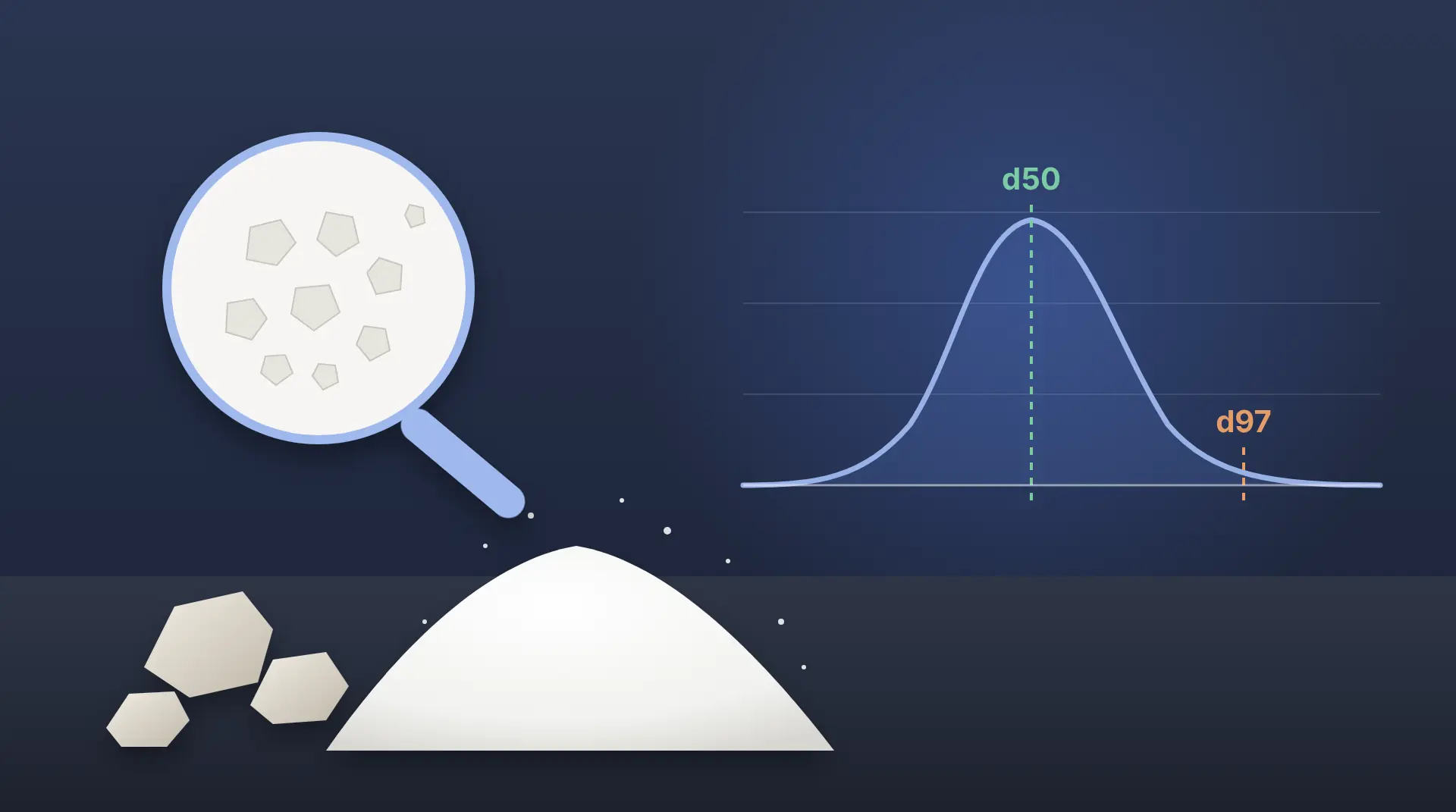
In short Micronized calcium carbonate is a fine mineral filler produced by grinding and classifying limestone or marble down to the micrometer range. The right grade is determined jointly by d50 (median particle size), d97 (coarse end), whiteness, purity, moisture and surface coating. This guide explains how to read these values and how to choose a grade for your application.
What is micronized calcium carbonate?
Micronized calcium carbonate (CaCO₃) is a fine powder obtained by grinding natural calcium carbonate rock down to the micrometer range. In the industry, these products are generically called ground calcium carbonate (GCC). In production, limestone is first crushed, then dry- or wet-ground and separated by classifiers into the required particle size distribution.
There is also precipitated calcium carbonate (PCC). The Calcium Carbonate Association Europe (CCA-Europe) defines PCC as a synthetic calcium carbonate produced industrially by carbonation. The association also emphasizes that for every end use there is a product whose fineness and particle size distribution are balanced to the technical requirements of that application. It states that calcium carbonate is the most widely used mineral as a filler and coating pigment in the paper, plastics, paint and coatings industries.
Vişne Madencilik's natural calcium carbonate comes from the Çukurova / Gündoğan (Ceyhan, Adana) quarry. According to the company, the limestone in this quarry has a CaCO₃ content above 97%. Product information is on the Natural Calcium Carbonate (GCC) product page.
How do you read d50, d97 and the top cut?
Particle size is described not by a single number but by a distribution. The two most commonly used values are:
- d50 (median size): Half of the particles are smaller than this size and half are larger. It indicates the overall fineness of the product.
- d97: 97% of the particles are smaller than this size. It indicates the coarse end of the distribution, known as the "top cut". Some suppliers give d98 or a separate "top cut" value for the same purpose.
Two products can have the same d50 but very different d97 values. The hypothetical example below illustrates this:
| Hypothetical product | d50 | d97 | What does it mean? |
|---|---|---|---|
| Product X | 3 µm | 12 µm | Narrow distribution; few coarse particles |
| Product Y | 3 µm | 25 µm | Same median size, but a longer coarse tail |
In thin sections such as thin films, fibers and thin-walled products, coarse particles increase the risk of defects. In these applications, d97 is therefore as important as d50. For thick sections or bulk-filling purposes, a broader distribution may be acceptable. A similar distinction applies to hydrated lime; for fineness criteria for hydrated lime, see our flue gas article.
What do whiteness, purity and moisture affect?
These three values are as decisive as particle size:
- Whiteness: Affects the final color of paint, paper and light-colored plastics. Always ask which method and measurement conditions the value refers to; whiteness values measured by different methods cannot be compared directly.
- CaCO₃ purity: As purity falls, the share of foreign minerals such as clay, silica or iron compounds rises. These minerals can change color, abrasiveness and chemical behavior.
- Moisture: High moisture can cause caking, flow problems and gas bubbles during plastics processing. Low moisture is particularly important in plastics and masterbatch applications.
When should you choose a coated or an uncoated grade?
Coated grades are usually preferred in water-repellent media such as polymers, and uncoated grades in water-based systems. In their natural state, calcium carbonate particles have a water-loving (hydrophilic) surface. When coated with a fatty acid such as stearic acid, the surface becomes water-repellent (hydrophobic), and the particles disperse more easily in the polymer.
| Product type | Typical use | Point to watch |
|---|---|---|
| Coated (stearic acid) | Plastics such as PVC, PP and PE; masterbatch | Coating level and uniformity of the coating |
| Uncoated | Water-based paint, paper, construction chemicals | Dispersion, whiteness, particle size distribution |
Vişne Madencilik states on its product page that stearic acid coating is available on request. Verify with small-scale trials which product type suits your formulation.
Which properties matter most in each application?
Each application puts a different property first. The table below can serve as a starting point; exact values depend on the formulation and the process.
| Application | Key properties |
|---|---|
| Plastics and masterbatch | d97 (top cut), low moisture, surface coating |
| Water-based paint | Whiteness, particle size distribution, oil absorption behavior |
| Paper | Whiteness, opacity, particle size distribution |
| Construction chemicals and mortars | Particle size distribution, purity |
| Wet flue gas desulfurization | CaCO₃ purity, fine grinding, reactivity |
For use in plastic recycling, see our plastic recycling application page; for paper, see our pulp and paper industry page.
Finely ground calcium carbonate is also used in flue gas treatment. The EU Large Combustion Plants BREF states that the finely ground limestone used in wet scrubbers should have a CaCO₃ content above 95%. We cover this use under limestone in wet flue gas desulfurization.
Share with us the particle size your application and formulation require. Talk to our team about calcium carbonate.
Which test methods should the technical data sheet state?
What a value means depends on how it was measured. Look for the following in the technical data sheet:
- Particle size: Measurement method and instrument. The international guideline for laser diffraction methods is ISO 13320. Because laser diffraction treats particles as spheres, sedimentation or sieve analysis may give different results for the same product.
- Whiteness: Method and measurement conditions.
- Use as a paint extender: ISO 3262-5:2023 specifies the requirements and test methods for natural crystalline calcium carbonate extenders.
- Coating: Coating agent and coating level.
- Batch certificate: The data sheet gives typical values; the certificate for each shipment shows the actual values of that batch.
Checklist before you order
- Define your application and process (e.g., PVC profiles, water-based interior paint).
- State the required d50 and d97 range and the measurement method.
- Specify whiteness, CaCO₃ purity and maximum moisture.
- State whether you want a coated or an uncoated grade.
- Add packaging, monthly quantity and delivery point.
- Request a certificate of analysis for every batch.
Compare the offers you receive on a delivered-cost basis, for products that meet the required specification. The method we use when comparing offers applies to calcium carbonate as well.
Frequently asked questions
Are micronized and ground calcium carbonate the same thing?
Micronized calcium carbonate refers to the fine, micrometer-range grades of ground calcium carbonate (GCC). Both are produced by mechanically grinding natural rock. The difference lies in the level of fineness, so the decision should be based on the d50 and d97 values, not on the product name.
Should I choose GCC or PCC?
GCC is produced by grinding natural rock, whereas PCC is produced by reacting hydrated lime with carbon dioxide. Particle shape and size are more tightly controlled in PCC. GCC, for its part, is an economical option in many filler applications. Which one is suitable depends on the requirements of the end product and on formulation trials.
Why is d97 as important as d50?
The d50 shows the overall fineness of the product, while the d97 shows how large the coarse particles can be. In thin films, fibers and thin-walled products, even a few coarse particles can cause surface defects or breaks. In these applications, looking only at d50 is therefore misleading; ask for both values.
Does calcium carbonate absorb moisture?
No. Calcium carbonate is chemically stable and does not react with water; it is not used as a moisture absorber. In industrial moisture absorbers, the substance that binds moisture permanently is calcium oxide (quicklime). The active substance in container moisture absorbers is CaO; we explain how it works in a separate article.
Can I use a coated grade in water-based paint?
It is generally not recommended. Because the coating makes the surface water-repellent, a coated grade can be difficult to disperse in water-based systems. Water-based paint, paper and construction chemicals mostly use uncoated grades. If you have a special formulation, decide on the basis of a small-scale trial.
What information should I share for a quote?
State your application, the required d50 and d97 range, your whiteness and purity expectations, whether you prefer a coated or uncoated grade, the monthly quantity, packaging and delivery point. With this information, we can define the right product and delivery terms. Send your calcium carbonate quote request.
Conclusion
- Micronized calcium carbonate is a fine filler obtained by grinding limestone or marble down to the micrometer range.
- d50 shows overall fineness and d97 the coarse end; for thin-section applications, both should be specified.
- Whiteness, purity, moisture and coating are as decisive as particle size.
- Values should be read together with their test methods, and the decision should be based on the batch certificate.
Send us the particle size, whiteness and packaging requirements of your application, and let us identify the right product together. We respond to your request within 24 hours.
Phone: +90 232 463 00 03 · Email: sales@visnemadencilik.com
Sources
- Life Cycle Analysis for Calcium Carbonate — Product: PCC-Dry — Calcium Carbonate Association Europe (CCA-Europe), 2021.
- ISO 13320:2020 — Particle size analysis — Laser diffraction methods — ISO, 2020.
- ISO 3262-5:2023 — Extenders — Specifications and methods of test — Part 5: Natural crystalline calcium carbonate — ISO, 2023.
- Best Available Techniques (BAT) Reference Document for Large Combustion Plants — European Commission Joint Research Centre (JRC), 2017, EUR 28836 EN (section 3.2.2.2.1).
- Vişne Madencilik: Natural Calcium Carbonate (GCC) product page (quarry, purity statement and coating option).
Author
Related articles
- Lime in flue gas desulfurization — limestone and other calcium reagents in wet scrubbers.
- How to select hydrated lime for flue gas treatment — fineness, surface area and purity.
- Hydrated lime for sale: how to compare offers — delivered cost per unit of active substance.
- How to choose a container moisture absorber — CaO, silica gel and calcium chloride compared.